In the past year, we’ve experienced what happens when the federal government tears down the infrastructure that provided many of the programs, funding streams, and overall support for Black disabled students.
The Trump administration has gutted federal agencies responsible for protecting disabled students. It has withheld millions of dollars in grant money from programs that supported Black and disabled learners, their families, and their educators. Offices that existed to enforce civil rights in education have been shut down or stripped of staff. The message being sent to Black disabled communities is that, more than ever, we are on our own.
New Disabled South’s Black Disability Institute has been tracking these attacks on Black disabled learners, and recently convened some of the top difference makers to discuss how and where to improve experiences for students, teachers, parents, and caregivers.
This partnership is significant because it brings together disability advocacy, lived experience, education policy, and the perspective of one of the country’s largest education organizations.
New Disabled South Leads The Discussion About Support For Black Disabled Learners
During the recent Congressional Black Caucus week in Washington, D.C., Shannon Stubblefield, Associate Director of Data and Research for New Disabled South, in partnership with Dr. Brittany Patrick, Senior Policy and Program Analyst, Disability Rights and Inclusion at NEA, organized a gathering of community members, educators, families, advocates, and organizational partners for “The Future We Deserve: Black Disabled Students, Families, and the Fight for Educational Equity.”
This group is the foundation for The Black Disability Policy Lab, a collaborative project between New Disabled South’s Black Disability Institute and the National Education Association (NEA). NEA is the largest labor union in the United States, representing public school teachers, higher-education faculty, education support professionals, and other education workers.
“I commend New Disabled South for bringing educators, advocates, families, and communities together to address these inequities and to advance an education system that truly serves every student. When we listen to those closest to our students and act collectively, we can build schools where every child has the resources, support, and opportunity they deserve.”
As a thought leader in disability justice across the South, the Black Disability Policy Lab was honored to help bring together some of the sharpest minds and most important voices working on these issues right now, people who understand what is being lost, what is being fought for, and what must be built next.
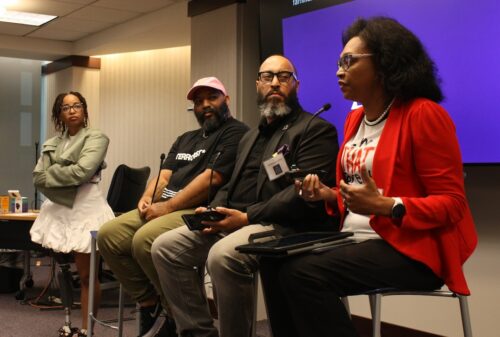
The event began with a panel discussion that put the reality of navigating educational spaces as a Black disabled person at the center of the conversation.
Shun Tucker-Allen, New Disabled South Director of Faith and Community Partnerships, started off the day by establishing the reasons and the need for the event, setting a tone for discovery and discussion. The conversation was led by entrepreneur, founder, and Black disability advocate Keri Gray, with panelists representing multiple perspectives in the fight for better educational support:
- AJ Link is openly autistic and holds a JD from The George Washington University Law School and an LL.M. in Space Law from the University of Mississippi School of Law. AJ currently serves as Director of Policy for New Disabled South and New Disabled South Rising.
- Theresa Smith, a Maryland-based mother of three children with special needs and a dedicated special education advocate. Through her advocacy practice, Pierce the Silence, she works to bridge educational policy and equitable student outcomes while helping families confidently navigate the special education system.
- Ver Shaun Terry, affectionately known as V, a transformational thought leader, Manager of Special Education at the Goodwill Excel Center, and leadership coach. V applies an empathy- and accountability-driven, systems-first approach to supporting people, driving results, and building healthy cultures.
During the discussion, we named the systemic barriers, the moments where the system has failed, and the places where communities have found ways to push through anyway. It was an honest, necessary conversion that helped the panelists and attendees better understand the many lived experiences in the room.
From there, participants moved into facilitated discussions that looked hard at both K-12 and higher education. What policies created these inequities? What practices make them worse? And most importantly, what do the people most affected by these systems actually need in order to thrive? The answers to those questions began to take shape as real, actionable policy recommendations. More to come on those.
Thought Leadership With Action In Mind
These were not theoretical conversations. They were the conversations that will shape what gets written into legislation and built into programs. We are preparing to rebuild with a new, better informed model that provides much more than just the bare minimum for Black disabled students.
“Every student deserves a public education where they are seen, valued, supported, and given the opportunity to thrive,” said Princess Moss, President of the NEA. “For Black students with disabilities, that means confronting the barriers created when race and disability intersect and ensuring that their voices and lived experiences are at the center of the conversation. I commend New Disabled South for bringing educators, advocates, families, and communities together to address these inequities and to advance an education system that truly serves every student. When we listen to those closest to our students and act collectively, we can build schools where every child has the resources, support, and opportunity they deserve.”
The work that started in those conversations is continuing. The project will next expand to programs at two HBCUs.
The Black Disability Policy Lab is preparing to take the work to North Carolina A&T State University and Mississippi Valley State University, with the broader goal of working alongside HBCUs to create spaces for Black disabled students, families, educators, advocates, and community leaders to shape education policy.
BCUs have historically served as important sites of innovation, liberation, leadership development, and systems change within Black communities. The Policy Lab is building on that history by creating opportunities for Black disabled people to shape the policies and systems that affect their educational experiences.
If you support this mission and would like to get involved, follow New Disabled South and the Black Disability Institute to find out how you can be a part of a better education system for everyone.